Ask a hotel chief engineer where the energy money goes and you get the same answer from Boracay to Baguio: hot water for the rooms and the laundry, the pool, the kitchen, and the chillers. The bill arrives as one number. The fix does not — each of those loads has a different best answer, a different payback, and a different right moment to do the work.
This is the playbook we use on real Philippine properties. The numbers below come from a published 32-room Philippine hotel benchmark at March 2026 industrial tariffs, and they scale roughly linearly with room count.
₱25,000 per room per year comes back from the hot-water retrofit alone.
+₱33,000 per room per year more when you add pool, kitchen and chiller scope.
Under 12 months payback on the integrated retrofit — around 24 months if you do hot water only.
First — how a heat pump actually works
If the physics is new to you, here is the honest version. You already own a heat pump: your aircon. An aircon moves heat from inside your room and dumps it into the street. A heat pump is the same machine run in the other direction — it collects heat from the outside air and puts it into your water. Same parts, opposite job.
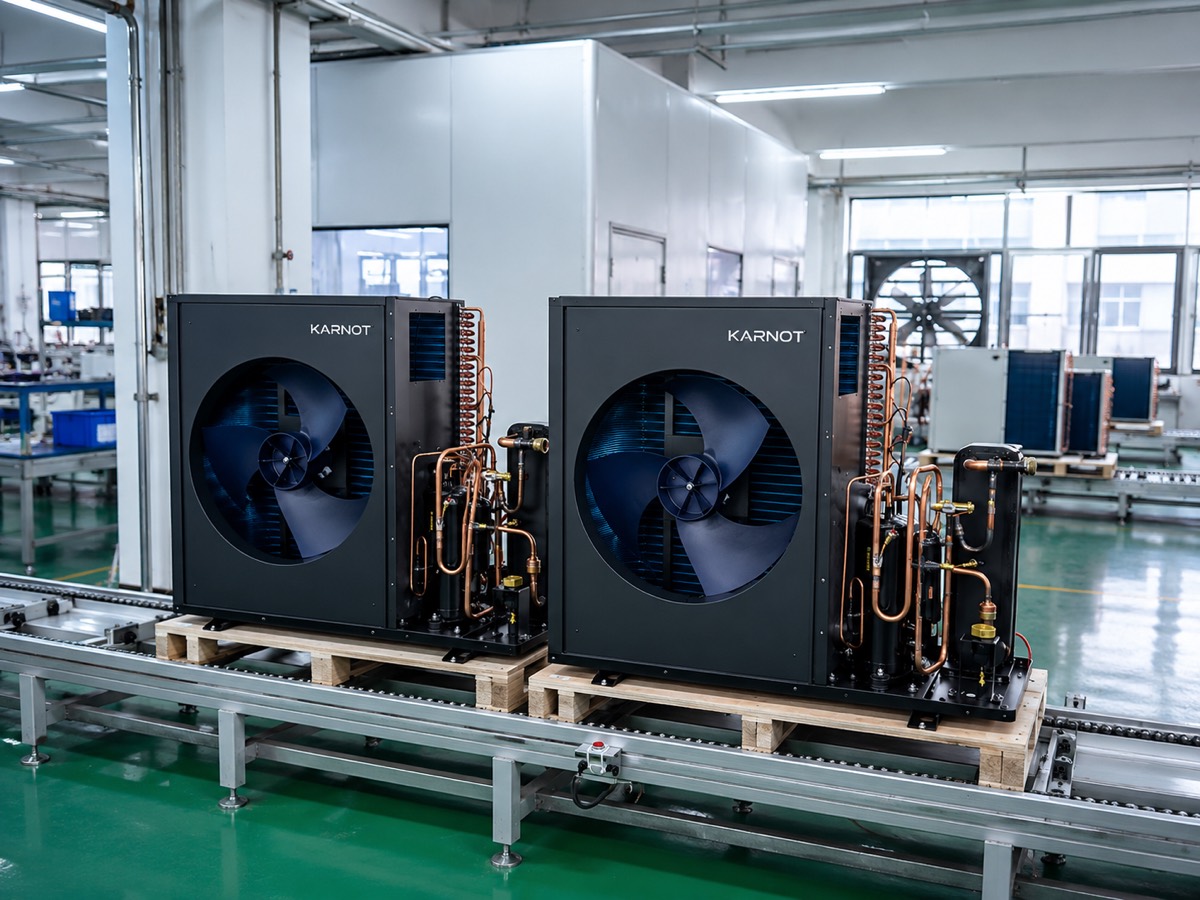
Inside the box, four things happen on repeat:
- The fan pulls warm Philippine air across a coil. The refrigerant inside boils at a low temperature and soaks up the air's heat — that heat is free, and it is there day and night.
- The compressor squeezes the vapour. Compressing a gas makes it hot — the same reason a bicycle pump warms up in your hand. This is the step that lifts free 30 °C air heat to useful 60–82 °C water heat.
- The hot refrigerant gives its heat to your water through a heat exchanger — hot enough for showers, laundry sanitation cycles and kitchen sinks.
- The refrigerant expands, cools, and goes round again.
The electricity you pay for only runs the fan and the compressor — it does not make the heat. The air makes the heat. That is why ₱1 of electricity in becomes about ₱4 of heat out, and why a machine like this behaves so well here: Philippine air is 28–35 °C all year round, which is a heat pump's favourite weather. The colder countries buying these machines by the million wish they had your climate.
Start with what a kWh of heat actually costs you
Every heating decision in a hotel comes down to one number: what you pay for each kWh of heat delivered into the water. At March 2026 industrial tariffs and fuel prices:
| How you make hot water | Cost per kWh of heat | Why |
|---|---|---|
| Electric resistance heaters | ₱12.10 | Every kWh of heat needs a full kWh of electricity |
| Diesel boiler | ₱7.20 | At ₱60/litre, plus flue losses |
| LPG boiler | ₱6.00 | At ₱60/kg, plus flue losses |
| Older heat pump (COP 2.5) | ₱4.85 | 2014–2018 units, aged and undersized |
| Karnot iHEAT — grid power | ₱2.70 | For every ₱1 of electricity, about ₱4 of heat |
| Karnot iHEAT — with solar | ₱0.40 | Heat pump powered by your own roof |
That table is the whole argument. A hotel on electric heaters pays ₱12.10 for what a heat pump on solar delivers for ₱0.40. Nothing else you can do to the building — LED lighting, key-card switches, BMS tuning — moves this much money.
The four loads, and the right answer for each
1. Hot water — rooms and laundry
The biggest single line. Guest showers, housekeeping, and the laundry's wash cycles all draw from the same plant. The answer is iHEAT — a reversible R290 heat pump in a sealed monobloc that heats water to 82 °C, hot enough for laundry sanitation cycles, from units spanning 9.5 to 105 kW. The refrigerant stays outside the building; only water enters the plant room. On the benchmark, this step alone is worth about ₱25,000 per room per year against LPG or diesel.
If yours is a boutique property under about 30 keys, a full plant room is overkill — the AquaHERO tank-integrated unit plugs into a standard outlet and does the same job at villa scale.
2. The pool
Pool heating on gas is one of the largest single energy lines a resort carries — and in summer the same pool overheats and guests complain it feels like soup. iSPA runs at COP 7.5: pay for one kWh of electricity, get over seven kWh of pool heat. That is about 85% less to run than gas, and the same machine cools the pool in the hot months. The heat exchanger is titanium — immune to chlorine, bromine and salt water, which matters on every coastal property.
3. The kitchen and cold rooms
Walk-in chillers, blast freezers and F&B cold rooms mostly run R404A — a gas with a global warming potential of 3,922 that is now on the same phase-down clock as R410A. iCOOL replaces them with CO₂ refrigeration: non-flammable, non-toxic, and with no phase-down schedule to strand the asset. The bonus most kitchens don't expect: the waste heat off the cold side becomes free hot water for the kitchen sinks.
4. Guest cooling
Where a central plant exists, iZONE hydronic fan coils serve the rooms with chilled water instead of refrigerant lines — below 30 dBA at low speed, quiet enough for luxury-class rooms, with no refrigerant in the guest space at all.
The order matters: pay for the next step with the last one
The mistake we see most often is trying to do everything at once — or doing the glamorous step first. The sequence that works financially:
| Phase | What happens | Typical payback |
|---|---|---|
| 1 · iMESH chiller upgrade | Adiabatic pre-cooling bolts onto the chillers you already own — any make, any refrigerant. 15–25% efficiency gain from day one. | Under 12 months |
| 2 · iHEAT hot water | Heat-pump plant replaces the LPG/diesel boiler on the next planned outage. ₱25K per room per year. | Around 24 months alone |
| 3 · Pool, kitchen, rooms | iSPA pool plant, iCOOL CO₂ cold rooms, iZONE fan coils — phased by room block, no guest disruption. | Part of integrated scope |
| 4 · iVOLT solar + storage | Zero-export solar sized to the reduced load, with battery. Brownout-proof as a side effect. | Integrated: under 12 months |
Phase 1 is the quiet hero. It needs no plant change, it works on the chillers you already paid for, and its savings are real money funding Phase 2 while the hot-water design is being done.
To deliver 100 kWh/day of heat, electric resistance needs around 50 solar panels. A Karnot heat pump delivering the same heat needs about 11 — it uses 78% less electricity for the same output. Electrify the load efficiently first and a quarter of the rooftop does the same job, leaving room for batteries. Sized this way, and configured zero-export, there is no grid-export cap to worry about.
The honest catch
Two things worth saying plainly. First, the sub-12-month payback belongs to the integrated scope — solar, heat pump and storage engineered as one project. A hot-water-only swap is a solid ~24-month payback, not a miracle. Second, heat pumps need somewhere sensible to put the outdoor units and a hot-water demand that actually exists — a property that fills twenty rooms a month should run the numbers before calling anyone, including us.
It is also worth knowing what happens if you do nothing: most hotel heat pumps installed in the 2014–2018 wave run R410A, whose recharge price has risen 3–5× since 2022 under the HFC phase-down that is now Philippine law. We covered that story — the gas, the salt air, and the service-cost curve — in a separate article.
What a project actually looks like
- Free site walk-around and pinch study — two hours on site, we pull 12 months of utility data, model the thermal load, and send an indicative report inside 14 days. No procurement triggered.
- Design and compliance — full hydronic design, R290 plant sizing to EN 378, BMS integration, plus RA 11285 / DOE classification support and the SEC PFRS S2 carbon model your head office will ask for.
- Phased install — cutover by room block; hot-water plant swaps on a planned outage. Guests never notice.
- Service — quarterly visits, Philippine-based parts depot (no 8-week air freight), 3-year warranty on the heat-pump core. Equipment life 15–20 years, with no refrigerant phase-down clock ticking inside it.
Energy-efficiency capital spend may also qualify for BOI fiscal incentives under RA 11285 — confirmed case-by-case, and we support the registration paperwork. Verify the specifics with your tax adviser.
Run your own numbers first
You don't need to talk to us to check any of this. The Hotel Retrofit Calculator is free and has no sign-up gate: rooms in, savings out — it models hot water, pool and laundry, sizes the system, and projects payback and CO₂ avoided. The Hot Water OPEX Estimator does the diesel-vs-LPG-vs-electric-vs-heat-pump comparison on one page.
Prefer the full document? The 18-page Hotels & Resorts application brief and the one-page flyer carry everything above with the engineering detail included.
Start with the free pinch study
Walk us through your plant room — kitchens, laundry, pool plant, chillers — and we'll come back inside two weeks with an indicative system, the payback, and the CO₂ you'd avoid. No obligation.
Book the site visit Run the calculator