Independence Day Briefing · 12 June 2026
Energy Independence Day 2031: the engineering roadmap
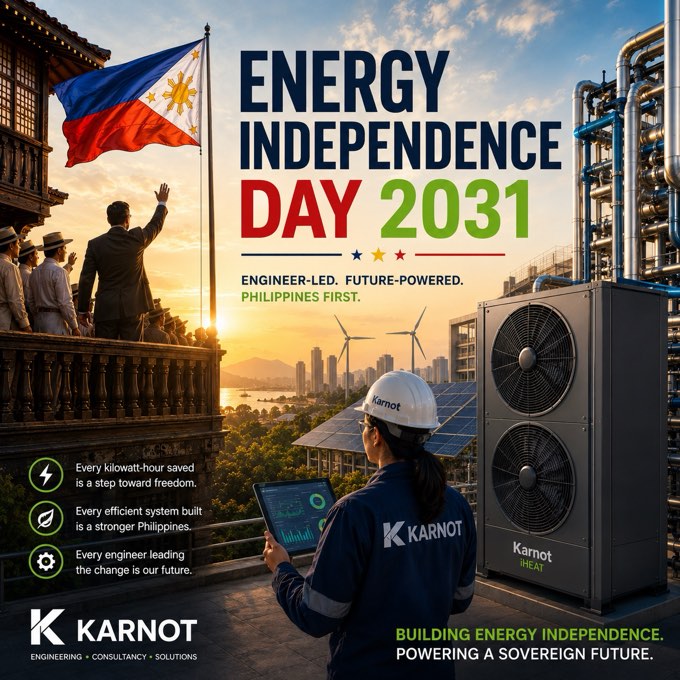
The Philippines declared political independence on 12 June 1898. Its energy independence can be declared on 12 June 2031 — not by politicians, but by the engineers and energy managers who run its boiler rooms, plant rooms and meters. Here is the technical case, from someone who has watched a nation do it once already.
Buyer’s guide: Commercial solar + storage — Zero-export solar that is cash-positive from month one.
National Energy System Operator (NESO), Great Britain — 2025 data Great Britain's grid averaged 129 gCO₂e/kWh in 2025 — and 2025 was the first full calendar year in British history with zero coal-fired electricity generation. As recently as 2012, the figure was around 500 gCO₂/kWh, with coal supplying 39 per cent of power.
- Philippine grid carbon intensity today: between 565 and 770 gCO₂/kWh depending on methodology — Ember-based analyses report 565–612 gCO₂/kWh; the IEA's 2025 emission factors table lists the Philippines at 770 gCO₂/kWh.
- Philippine fuel exposure: 98 per cent of crude imports and 91 per cent of LPG sourced from the Middle East, transiting the Strait of Hormuz — closed to commercial shipping since late February 2026 (see our Hormuz briefing).
- Great Britain's grid in 2025: average 129 gCO₂e/kWh; first full calendar year with zero coal generation (NESO).
- Great Britain's grid in the mid-1970s: dominated by coal and oil; carbon intensity estimated to approach 700–800 gCO₂/kWh — comparable to the Philippine grid today.
- Philippine law already in force: Republic Act 11285, the Energy Efficiency and Conservation Act (2019), requires designated establishments to appoint certified energy managers and conduct energy audits.
Today the Philippines marks 128 years since General Aguinaldo proclaimed independence from a balcony in Kawit, Cavite. It marks the anniversary under a declared national energy emergency, with the Strait of Hormuz closed, diesel at ₱85–90 a litre against a pre-crisis ₱54, and rotational brownouts across Luzon and the Visayas.
Political independence was won in 1898. Energy independence has never been attempted.
This briefing makes a specific claim: the Philippines can celebrate its first Energy Independence Day on 12 June 2031 — five years from today — and the campaign that gets it there will be led not by legislation alone, but by the country's energy managers, certified energy auditors and conservation engineers. This is the engineering roadmap.
I have seen a nation do this. I grew up inside it.
I was a child in 1970s Britain. I remember the three-day week of 1974, when the government rationed electricity to industry because the miners were on strike and the oil had tripled in price after the 1973 embargo. Television stopped at half past ten to save power. My mother kept candles in the kitchen drawer the way Filipino households keep them now for brownouts. Two governments fell, in part, over energy. The soundtrack to all of it was punk, and then the New Romantics — a generation refusing to accept that decline was permanent.
The grid that powered that childhood ran on coal and oil. Its carbon intensity, by reasonable estimate, approached 700–800 gCO₂/kWh — almost exactly where the Philippine grid sits today on the IEA's numbers.
That same British grid averaged 129 gCO₂e/kWh in 2025. It has just completed its first calendar year in history without burning a single tonne of coal for electricity.
Nations can transform their energy systems within one working lifetime. I am not theorising. I watched it happen.
And here is the part that matters for Manila: Britain's transformation was not delivered by slogans. It was delivered by engineers — grid planners, efficiency engineers, project developers — working inside market mechanisms that made the clean option the cheap option. The Philippines does not need to spend forty years rediscovering that. The technology Britain had to invent along the way already exists, is already certified, and is already running in Philippine facilities.
The intensity ladder: where the Philippines stands
Sources: NESO 2025 annual data; IEA Emission Factors 2025; Ember-based analyses report the Philippines at 565–612 gCO₂/kWh on alternative methodologies. The 1970s GB figure is an engineering estimate for a coal-and-oil-dominated grid.
What energy independence actually means
Energy independence does not mean producing every kilowatt-hour domestically. No serious economy attempts that. It means something more precise: no single foreign chokepoint can shut down Philippine kitchens, hospitals, factories or cold chains. By that definition, every litre of diesel and every kilogram of LPG that a Philippine facility stops burning is a unit of sovereignty recovered.
The good news is that the largest, fastest, cheapest reductions are not in power stations. They are behind the meter — in the boiler rooms, hot water systems, kitchens and process lines of the country's hotels, hospitals, food manufacturers and cold storage operators. That is energy-manager territory. That is why this must be an engineer-led revolution.
The five workstreams
1. Electrify heat — the single biggest lever
Most imported fuel in a Philippine commercial or industrial facility is burned to make heat: hot water, steam, drying, cooking, sterilisation. A boiler converts one unit of fuel into, at best, slightly less than one unit of heat. A heat pump does something fundamentally different — it does not make heat, it moves it, using the vapour-compression cycle to pump heat from the surrounding air or a water source into the process. The result is that one unit of electricity typically delivers three to four units of heat. Run the conversion on your own plant with our public boiler-to-heat-pump calculator.
Modern natural-refrigerant machines remove the old temperature objection. R290 (propane) heat pumps deliver hot water at the temperatures hotels, hospitals and food plants actually use, and transcritical CO₂ systems push process hot water to 120°C — boiler-replacement territory. These are not laboratory machines: our European OEM partners have more than ten thousand units deployed across the EU, with Keymark, CE and MCS certification on the R290 range. In the Philippines they are already running at an aviation MRO facility in Manila with verified savings, and at a food manufacturer in Bulacan.
Every LPG boiler retired is a kitchen that never appears in the next fuel-shortage headline.
2. Solar behind the meter — the regulatory door is already open
Distributed generation rules in the Philippines are further ahead than most facility owners realise. Under DOE Department Circular DC 2024-06-0018, a self-generation facility operating in zero-export configuration faces no capacity cap — a factory or resort can build solar sized to its own load without exporting a single watt. For those who do want to export, the April 2026 circular lifted the net-metering ceiling to 1 MW.
The pairing matters more than either measure alone: a heat pump converts a fuel bill into an electrical load, and rooftop solar serves that load during exactly the daytime hours when hotels heat water and factories run process lines. Fuel exposure goes to zero; the marginal cost of heat trends towards the cost of sunlight. Size the pairing for your own roof with the solar and battery calculator.
3. Thermal storage — store the heat, not the electrons
Batteries get the headlines, but for heating and cooling loads there is a cheaper ladder: chilled-water storage, then ice storage, then phase-change materials. Storing energy as hot or cold costs a fraction per kilowatt-hour of storing it as electrons, and it lets a facility run its heat pumps on midday solar and draw down the thermal bank through the evening peak — precisely when the grid is dirtiest and most fragile. The arithmetic is simpler than most people expect — a thousand litres of hot water holds 46.5 kWh across a 40-degree swing; our thermal storage calculator does the rest.
4. Demand flexibility — turn ten thousand facilities into a power station
A grid on red alert does not only need more generation; it needs less simultaneous demand. Facilities with heat pumps and thermal storage can shift load by hours without any loss of service — pre-chilling, pre-heating, riding through the peak. Aggregated across hundreds of sites, that flexibility behaves like a virtual power plant, and it is the cheapest "capacity" the Luzon grid will ever procure.
5. Measure, verify, certify — the human infrastructure
None of this scales without people, and the Philippines has already legislated for them. Republic Act 11285 — the Energy Efficiency and Conservation Act — requires designated establishments to appoint certified energy conservation officers and energy managers and to conduct regular energy audits. That is the officer corps of this revolution, already commissioned by law. What it has lacked is a mission worthy of the title. Energy Independence Day 2031 is that mission: every audit a reconnaissance, every retrofit a recovered position, every verified kilowatt-hour a line in the ledger of sovereignty.
The five-year campaign plan
Year one — 2026–27: audit and pilot. Every designated establishment completes its RA 11285 audit with a fuel-displacement plan, not just an efficiency plan. First-mover facilities commission heat pump and solar pilots; their energy managers publish the verified numbers.
Year two — 2027–28: scale and prove. Pilot data converts CFOs. Energy-as-a-service and shared-savings structures remove the capex objection. By the May 2028 election, every province should have at least one visible, ribbon-cuttable facility that has switched off imported fuel — energy independence at the barangay scale, exactly the constituency-level proof point politicians need.
Years three and four — 2028–30: mainstream. What was innovative becomes specification. Boiler replacement defaults to heat pump replacement. Zero-export solar becomes a standard line item in every new resort, hospital and plant.
Year five — 12 June 2031: declare it. The first Energy Independence Day is celebrated not with promises but with a national ledger: litres of diesel displaced, tonnes of LPG never imported, megawatt-hours shifted off the peak — compiled facility by facility, signed off by the engineers who delivered it.
To the people who will actually do this
To the energy managers and CEMs: you already hold the legal mandate and the meter data. The audit you file this year can be a compliance document, or it can be a war plan. Choose the war plan.
To the CFOs: this is not an environmental purchase. A heat pump displacing LPG or diesel is a hedge against the most volatile line on your P&L, and with shared-savings structures the cash flows positive from month one. Run the numbers on your own fuel bill — our sizing calculators are public.
To the LGU executives: the facility in your province that switches off imported fuel is a photo opportunity no rival can match. Provide the political cover and the procurement certainty; the engineers will provide the result.
To the 20th Congress: the bar from our Hormuz briefing stands — amend the 1998 Downstream Oil Deregulation Law, legislate a strategic petroleum reserve, accelerate electrification incentives. Three bills. But do not wait for them to start; nothing in the five workstreams above requires a single new law.
Let this be an engineer-led revolution. The country I grew up in had your grid. Look at it now.
A note from a Filipino-incorporated cleantech company
Karnot Energy Solutions Inc. was incorporated in the Philippines on 19 June 2025, with a BOI-SIPP registration in process, and is headquartered at the Low Carbon Innovation Centre in Mapandan, Pangasinan. We commercialise natural-refrigerant heat pump and cooling systems — CO₂ and R290 — built with OEM partners who have deployed over ten thousand units across the EU, with Keymark, CE and MCS certification on the iHEAT R290 range. Our Philippine footprint includes an aviation MRO facility in Manila with verified savings and a food manufacturer in Bulacan. We are a Philippine company solving a Philippine problem. Energy Independence Day 2031 is the problem statement; the plant room is where it gets solved.