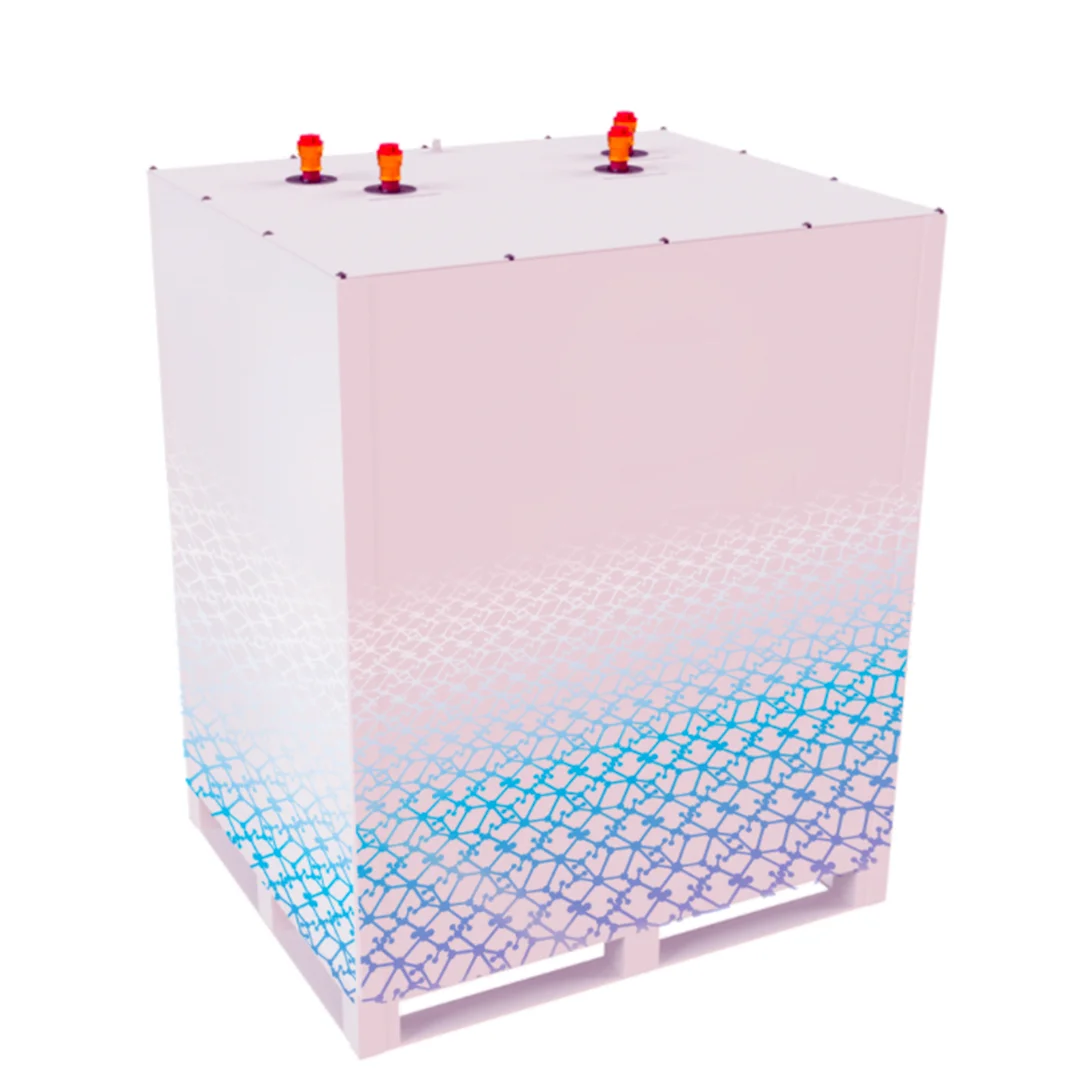
Karnot Permafrost P11 Thermal Battery
Dynamic cooling energy storage for air conditioning and process control
The Karnot Permafrost P11 provides highly efficient cooling energy storage using Plentigrade P11 phase change material. Designed for air conditioning load shifting and process cooling applications, the Permafrost P11 decouples cooling generation from demand, enabling off-peak energy capture and on-demand cold delivery with ultra-low standby losses.
Key Features & Advantages
Engineered for dynamic cooling performance and operational flexibility — the Permafrost P11 delivers powerful cold storage in a compact, efficient package.
Dynamic Cooling Power
Delivers 33 kWh of cooling capacity for air conditioning and process control, storing cold energy generated during off-peak periods for on-demand use.
Flexible Dual Circuits
Features two independent hydronic circuits (High Power and Low Power) that can be configured to suit any cooling application and load requirement.
Energy Resilience
Shift cooling loads to cheaper off-peak tariffs and maintain cooling supply during peak demand periods or grid interruptions.
Ultra-Low Standby Loss
Engineered for maximum retention, with an exceptionally low standby energy loss of just 0.66 kWh per 24 hours.
Technical Specifications
Comprehensive specifications for system design and installation planning.
Performance & Capacity
| Nominal Storage Capacity | 33 kWh112.6 kBTU |
| Standby Stored Energy Loss Rate | 0.66 kWh / 24h2.25 kBTU / 24h |
| Design Discharge Outlet Temperature | 12°C53.6°F |
| Charging Source Temperature | 0°C to 8°C32°F to 46.4°F |
| Phase Change Material | Plentigrade P11 |
Operational & Physical
| Max Flow Rate (High Power Circuit) | 50 L/min13.2 gal/min |
| Max Flow Rate (Low Power Circuit) | 40 L/min10.6 gal/min |
| Maximum Working Pressure | 1.6 MPa (16 bar) |
| Dimensions (W × D × H) | 1200 × 1000 × 1470 mm47″ × 39″ × 58″ |
| Weight | 1,268 kg2,795 lbs |
Additional Advantages
Beyond core performance, the Permafrost P11 delivers system-wide benefits that transform how you manage cooling energy.
System Benefits
- Decouples cooling generation from cooling demand
- Enables demand side management and shifts cooling loads to cheaper off-peak tariffs
- Modular and scalable — thermal batteries can be connected in series or in parallel to increase cooling storage capacity
- Integrates with chillers, heat pumps, and free cooling sources
- Reduces peak electrical demand by buffering cooling loads
- Supports air conditioning, data centre cooling, and industrial process control applications
Lower Costs
A Karnot Permafrost P11 thermal battery is clean and fast to install. Running costs are low because mandatory annual maintenance and inspections are not required. Shift cooling to off-peak electricity tariffs and reduce demand charges for significant operational savings.
Note: As an innovative company committed to continuous improvement, our products are subject to change without prior notice. Always refer to the latest version of this document.
Ready to Optimise Your Cooling Storage?
Contact our technical team for system design assistance and detailed project specifications.
Contact SalesFrequently Asked Questions
Quick answers to the questions most commonly raised by engineers and facility managers evaluating the Permafrost P11 chilled-water cooling battery for commercial HVAC and process cooling applications.
What is the Karnot Permafrost P11?
The Permafrost P11 is a phase change material (PCM) cooling battery with 33 kWh nominal storage capacity, optimised for commercial chilled-water applications. It is charged at 0–8°C and discharges at 12°C through two independent hydronic circuits. Footprint is 1200×1000×1470 mm and weight is 1,268 kg.
What applications use 12°C chilled-water discharge?
The P11's 12°C dispatch matches the standard chilled-water loop temperature in most commercial buildings — offices, hotels, malls, hospitals, BPO floors, supermarket dry-zone air conditioning, and process cooling for light industry. The P11 sits between the chiller and the building's fan-coil network, banking cooling capacity for peak demand.
How does the Permafrost P11 reduce demand charges?
Philippine commercial bills include a demand charge based on the highest 15-minute kVA peak of the billing period. By charging the P11 overnight or during off-peak hours and dispatching its cooling during the daytime peak, the chiller can run at lower nameplate during peak periods. This shaves the 15-minute peak, often the single largest controllable line on the bill.
What is the difference between Permafrost P11 and P5?
Both are PCM cooling batteries in the same cabinet. The P11 dispatches at 12°C and is suited to commercial HVAC chilled water. The P5 dispatches at 6°C and is suited to cold storage and refrigerated applications. The P11 has a tighter charging range (0–8°C) than the P5 (-40–3°C).
How does the P11 pair with Karnot iCOOL or other chillers?
Any chilled-water source charges the P11 — Karnot iCOOL CO2, traditional R134a or R513A chillers, or absorption chillers. The P11 sits hydraulically in parallel or in series with the existing system and is controlled by a simple charge/discharge schedule aligned to tariff or PV generation.
Why use a chilled-water thermal battery instead of a lithium battery for HVAC?
For buildings whose primary electrical load is air conditioning, storing cooling directly is typically 5–10× cheaper per kWh than storing electricity in lithium to run the chiller on demand. There are no rare earths, no fire risk, no chemistry that degrades, and no thermal runaway concerns.
Can multiple Permafrost P11 units be connected together?
Yes. The P11 is modular and scalable. Multiple units can be connected in series or in parallel to increase total cooling storage capacity. This allows the system to be sized to the load and expanded later without replacing existing equipment.