Six heat pumps. One water loop.40% off the office HVAC bill.
For Philippine offices, hotels, hospitals and malls. Replace the wall of split-type DX units with one central plant of five or six 50 kW reversible iHEAT R290 heat pumps making chilled and hot water, piped to iZONE hydronic fan coils in every zone. The heat it pulls out of the floors makes your hot water for free — the R290 stays outside at the plant. Water runs through the building, not refrigerant.
A split unit in every room is a refrigerant leak in every room.
A typical Philippine office runs dozens of split-type DX units — or a VRF system piping R410A through the ceiling of every occupied space. Each runs at COP ~3, leaks F-gas, throws its waste heat onto the roof, and fails on its own schedule. One central plant of 50 kW heat pumps making water does the same job at COP 4.5, recovers the heat, and keeps the refrigerant outside.
VRF pumps R410A through the ceiling of every room
VRF and split DX circulate R410A (GWP 2,088) in long pipe runs through occupied offices — a leak risk over every desk and a growing Scope 1 liability under SEC PFRS S2, on the Kigali phase-down clock. Karnot keeps R290 sealed at the outdoor plant and circulates only water indoors. No F-gas in the building, nothing with a refrigerant retirement date, nothing to leak over your staff.
A hundred small compressors at COP 3, and a morning peak you pay for
Split units run at COP ~3 and each short-cycles against its own room; the building's sharp morning cool-down creates a 15-minute demand peak that is a charge in its own right. One modular R290 plant at COP 4.5 stages units to match the real load, recovers the cooling heat as free hot water, and lets iSAVE pre-cool storage to shave the peak.
One central plant. Chilled water out, hot water back.
Five or six 50 kW reversible R290 modules make 7 °C chilled water and 45–60 °C hot water at the outdoor plant, piped to iZONE fan coils in every zone. In 4-pipe, the heat from cooling makes the hot water. Water in the building, not refrigerant.
iHEAT R290 · 50 kW modules
The central plant. Five or six 50 kW modules on one water loop, staging to match load and giving N+1 redundancy — service one, the building runs on the rest. 7 °C chilled + 45–60 °C hot water. Small sealed R290 charge per module, EN 378, GWP 3.
iZONE fan coils
A fan coil for every space — ceiling cassettes for open-plan, concealed ducted units for meeting rooms, exposed and floor-standing for lobbies and retrofits. 2-pipe or 4-pipe, per-zone control. Water in the building, not refrigerant.
iSAVE
Building-management control of every zone, plus demand-peak shaving on the air-conditioning load — usually the biggest controllable line on an office bill. Monthly IPMVP M&V report to owner and lender.
iVOLT + iSTOR
An office's cooling load is entirely daytime — a perfect match for solar, with no wasted load at night. iVOLT zero-export PV runs the plant on free midday sun; iSTOR banks chilled water to ride the afternoon peak. Another 30–50% off the bill.
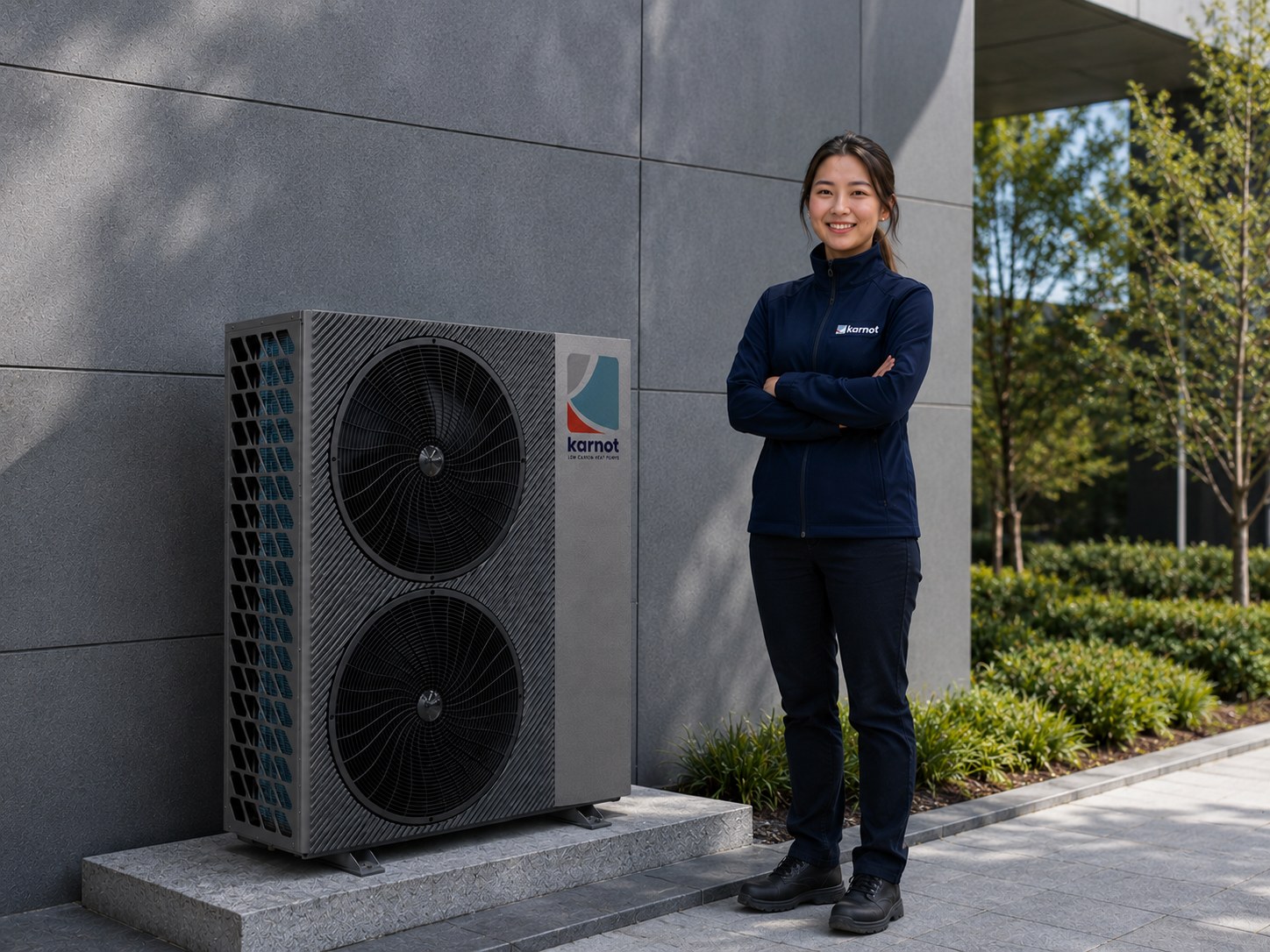
3,000 m² office. One plant instead of fifty split units.
Modelled on a 3,000 m² Philippine commercial office on split-type DX or VRF, switching to a central plant of 5–6 × 50 kW reversible iHEAT R290 modules with iZONE hydronic fan coils.
| Annual figure · 3,000 m² office | Today · split DX / VRF | Karnot central R290 hydronic | You stop paying |
|---|---|---|---|
| Cooling electricity | COP ~3 · R410A | COP 4.5 · R290 | ~₱0.8M/yr |
| Hot water / DHW | Separate electric heaters | 0 · recovered from cooling | ~₱0.2M/yr |
| Demand charge (morning peak) | Unmanaged 15-min peak | iSAVE pre-cool + shave | ~₱0.4M/yr |
| Refrigerant in occupied spaces | R410A GWP 2,088 · leaks 5–10%/yr | R290 GWP 3 · plant only | Scope 1 + leak liability |
| Total HVAC + DHW bill | ~₱3.6M/yr | ~₱2.2M/yr | −40% / ~₱1.4M |
The running saving. Plain and dull.
About ₱1.4M a year off the HVAC and hot-water bill, every year. On a new build the system costs about the same to install as the VRF you were going to buy anyway, so that saving is very nearly free.
On a new build you were going to spend on VRF anyway. Spend it on water instead.
VRF and a central R290 hydronic plant cost roughly the same to install on a new office or major refurbishment — both need indoor units and distribution. The difference is what runs through the building, how efficiently, and whether the heat is wasted.
VRF pipes R410A through every ceiling — F-gas over occupied desks, on the phase-down clock. Karnot circulates water; the R290 stays sealed at the outdoor plant. Nothing to leak on staff, nothing with a retirement date.
A modular plant at part load is far more efficient than fifty small compressors. In 4-pipe it recovers the cooling heat as free hot water instead of dumping it on the roof — a saving VRF cannot make.
Same capital line as the VRF you were going to buy, about 40% lower running cost, plus a morning peak shaved by iSAVE and a plant with no F-gas phase-down date. The incremental payback against VRF is close to immediate.
You pay nothing up front. The bank does.
Three Philippine banks run green-loan programmes built for exactly this kind of building project. On a new build the running-cost saving covers the loan payment with cash to spare. Net cash flow goes up from day one.
Plus BOI Pioneer Income Tax Holiday under RA 11285 for qualifying green developments. Karnot files the loan, the BOI registration, the building permits and the monthly IPMVP M&V report your lender wants to see as part of project scope.
Download the HVAC & Building Climate Pack
A 4-page application brief and a 10-slide deck — the hydronic-vs-VRF case, the central R290 plant, the office numbers and bank finance — ready to share with your developer, building owner or M&E consultant.
4-Page Application Brief
A4 portrait PDF · print-ready. Hero, the split-unit problem, the central-plant architecture, the 3,000 m² office numbers, hydronic-vs-VRF, and bank finance.
10-Slide Sales Deck
16:9 landscape PDF. The full presentation — the problem, the central R290 plant, the four products, the bill, hydronic-vs-VRF, the refrigerant case and next steps.
Frequently Asked Questions
How much can an office save versus split-type DX or VRF?
A modelled 3,000 m² Philippine office served by a central plant of five or six 50 kW reversible iHEAT R290 heat pumps (up to ~300 kW, N+1) cuts its combined HVAC and hot-water bill by about 40% — from roughly ₱3.6M/year on split DX or VRF to about ₱2.2M/year, about ₱1.4M/year saved. On a new build or refurbishment the CAPEX is comparable to a VRF install, so the incremental cost over VRF is small and the incremental payback is under a year; a full retrofit pays back on running cost in roughly 5–6 years.
What is a hydronic fan coil system, and how is it different from VRF?
A central plant of heat pumps makes chilled water (~7 °C) and hot water (45–60 °C) outdoors and circulates water through the building to iZONE fan coils. VRF instead pumps refrigerant (R410A) through pipe runs to every indoor unit. The hydronic difference: the R290 stays sealed at the outdoor plant (no F-gas in occupied spaces), the central plant runs at higher COP (4.5 vs ~3), and a 4-pipe configuration heats and cools at once, recovering the cooling heat as free hot water.
Why five or six 50 kW heat pumps instead of one big chiller?
Modular 50 kW R290 units give three advantages: redundancy (one module can be serviced or fail without losing the building — an N+1 plant); part-load efficiency (the plant stages units to match the real load, holding a high COP at 30–60% where a single big compressor would short-cycle); and charge safety (each module carries a small sealed propane charge under EN 378 rather than one large charge). They cascade on a single water loop to ~300 kW.
What fan coil types does Karnot offer?
iZONE hydronic fan coils come in every format an office needs: recessed ceiling cassettes for open-plan, concealed ducted units above meeting-room ceilings, exposed wall or under-window units for retrofits with no ceiling void, and floor-standing or tower units for lobbies and atria. All run on the same chilled and hot water loop, in 2-pipe or 4-pipe, with per-zone control through iSAVE. Because they circulate water, there is no F-gas in any occupied space.
How does a 4-pipe system make hot water for free?
A reversible heat pump in 4-pipe configuration heats and cools at once: the heat removed from the rooms during cooling is delivered straight to the hot-water tank instead of being thrown onto the roof. So the DHW for pantries, toilets and end-of-trip showers becomes a by-product of the cooling you were doing anyway. iSTOR thermal storage buffers the hot and chilled water so supply and demand need not line up minute by minute.
Is R290 (propane) safe to use in an office building?
Yes. Each module's R290 charge is sealed in the outdoor plant in a small quantity under the EN 378 standard — it never enters the occupied building; only water circulates indoors. That is inherently safer than VRF, which distributes refrigerant through occupied ceilings. R290 has a GWP of 3 (vs R410A's 2,088) and no phase-down exposure.
What financing and incentives are available?
Three Philippine banks run green-loan programmes that fit building HVAC CAPEX: DBP SEFP (~6.5–8% p.a., 70–80% LTV), LandBank SEILP (~7% p.a.), and BPI SDF (~1–1.5% below SME). Most qualifying green developments also qualify for BOI Pioneer status and an Income Tax Holiday under RA 11285. Karnot files the loan, the BOI registration, the building permits and the monthly M&V report as part of project scope.
Designing or refurbishing an office?
Send us the floor area, occupancy and your HVAC + DHW design brief. We come back with a sized central R290 plant (how many 50 kW modules), an iZONE fan coil layout, the projected saving against VRF, payback — and the bank application ready to sign.