Your chiller fights the afternoon heat.iMESH cools the air first.
For every air-cooled chiller, VRF condenser and aircon outdoor unit in the Philippines. A fine mist evaporates on a mesh screen in front of the coil, so the air arrives several degrees cooler and the compressor does less work for the same cooling. 20–30% off the cooling electricity, bolted on in days, zero downtime — and the refrigerant circuit is never touched.
The hottest hour of the day is your chiller's worst hour to work.
An air-cooled chiller or aircon condenser has to push heat into the outdoor air. The hotter that air, the higher the head pressure, the harder the compressor works — so efficiency is worst at 2 pm, exactly when the building needs cooling most and the demand-charge meter is watching. Cool the air before the coil, and the whole problem shrinks.
Efficiency collapses exactly at the afternoon peak
At 35 °C condenser air, a chiller burns far more electricity per kW of cooling than it does in the morning — and the 2–4 pm crunch sets the 15-minute demand charge for the month. iMESH gives the condenser several degrees of cooler air in exactly those hours, so the savings land where each kWh costs most.
Ageing plant derates in the heat — replacement costs millions
Older R22 and R410A chillers lose capacity on hot days just when it is needed, and a like-for-like replacement is a multi-million-peso, multi-month project. iMESH is a bolt-on frame fitted in days that restores hot-day capacity and cuts the bill — buying an ageing plant years of useful life while you plan the upgrade properly.
A mesh screen, a fine mist, and physics does the rest.
Water evaporating takes heat with it. iMESH puts that to work a few centimetres in front of your condenser coil — the mist evaporates on the mesh, the air arrives cool and dry, the coil never gets wet.
The mesh screen
A woven screen mounts in front of the condenser face. Fine nozzles wet it when the air is hot; evaporation on the mesh cools the incoming air several degrees. As a bonus, the mesh catches leaves and dust before they reach the coil.
Smart water control
Temperature-controlled misting runs only in the hours that justify it — about 95% less water than a cooling tower. Softened, RO or DI supply used where the water is hard; your site already runs both.
Fits what you already own
Split-type and packaged aircon outdoor units, VRF condensers, air-cooled chillers, dry coolers and cold-room condensing units — any equipment that rejects heat to air, any refrigerant, any age.
Proof by meter
We log the equipment's kWh before and after, so the saving is read off your own meter, not our brochure — the same measurement discipline as every Karnot install.
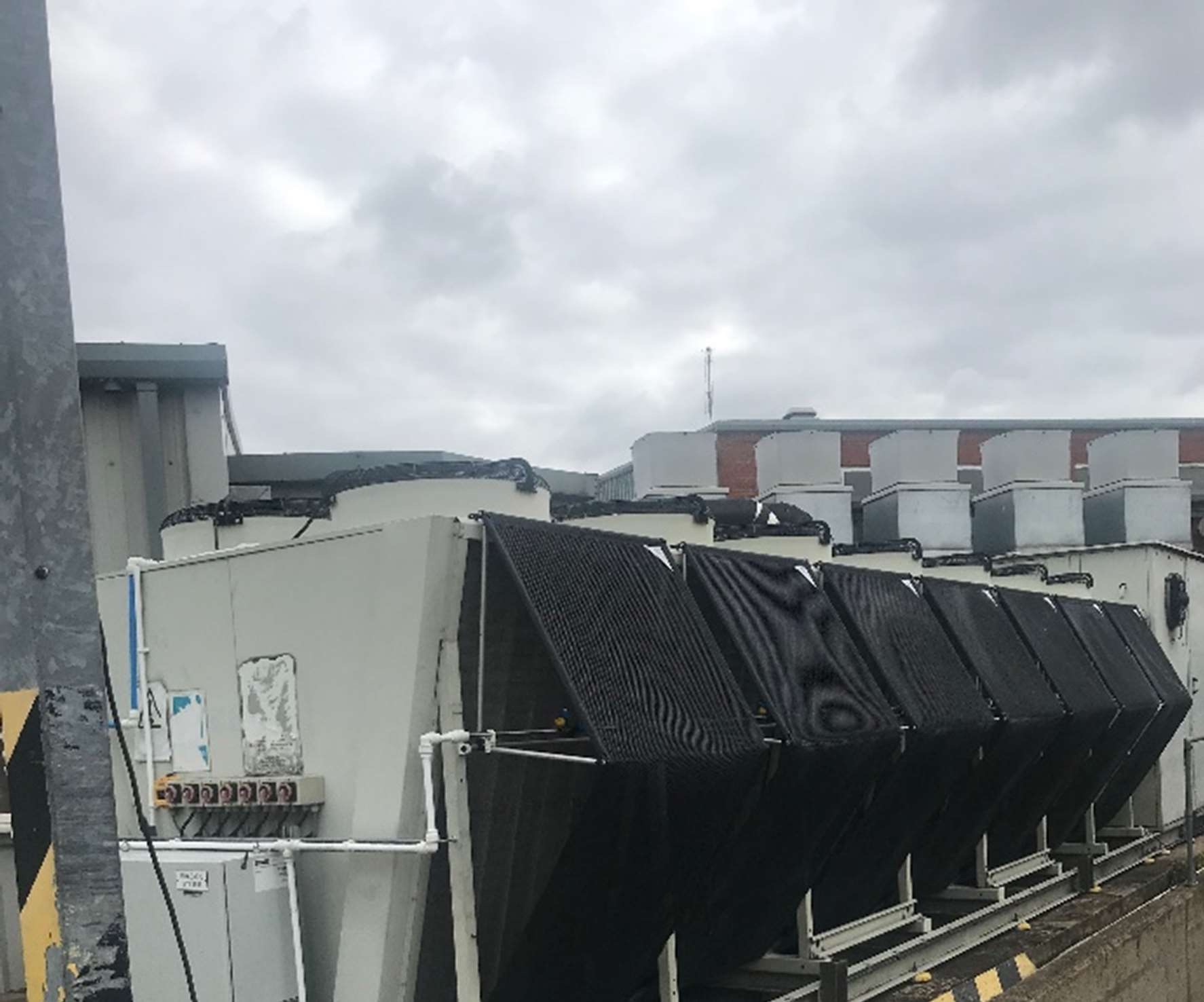
A 100 kW chiller's bill, before and after the mist.
Modelled on a 100 kW air-cooled chiller in a Philippine plant — 10 hours a day, 300 days a year, grid power at ₱14/kWh.
| Annual figure · 100 kW chiller | Today · bare condenser | With iMESH | You stop paying |
|---|---|---|---|
| Chiller electricity | ~₱1.4M/yr | ~₱1.05–1.1M/yr | ~₱280–350K/yr |
| Hot-day capacity | Derated at 35 °C | Restored by pre-cooled air | Lost production hours |
| Demand peak (2–4 pm) | Worst-hour COP sets the charge | Softened at the source | Part of the demand line |
| Water for misting | — | ~₱10K/yr | (small cost added back) |
| Cooling electricity | ~₱1.4M/yr | ~₱1.1M/yr | −20–25% |
The smallest first step in energy saving. And the fastest.
No civil works, no refrigerant permit, no downtime, no new plant. A frame, a mesh, a water line and a controller — and the saving starts the day it is switched on.
Three ways to fix a struggling chiller. One costs a fraction of the others.
When cooling costs too much or capacity falls short on hot days, the usual answers are a new chiller or a conversion to water-cooled plant. Both have their place — but both cost millions and take months. The mist screen is the step to take first.
A like-for-like replacement buys efficiency at full capital price, with craneage, downtime and permits. Right eventually — but iMESH defers it for years and keeps working on the new plant too.
Water-cooled plant is efficient but brings tower maintenance, chemical treatment and legionella management — and about twenty times the water use. A serious undertaking for a serious plant room.
A bolt-on mesh and mist screen giving 20–30% of the saving for a fraction of the cost, fitted in days with zero downtime. Start here, measure, then decide what else the meter says is worth doing.
Frequently Asked Questions
How much electricity does iMESH save?
Typically 20–30% of the cooling equipment's electricity, biggest on the hottest afternoons. On a modelled 80 kW R22 chiller retrofit the system COP rose 2.56 → 3.45 and annual electricity fell about 19%. On a modelled 100 kW Philippine chiller (10 h/day, 300 days, ₱14/kWh) a 20–25% saving is worth roughly ₱280–350K a year against a water cost of a few hundred pesos a week.
How does adiabatic pre-cooling work?
A woven mesh screen mounts just in front of the condenser coil, and fine nozzles wet it when the air is hot. The water evaporates on the mesh, cooling the air several degrees before it reaches the coil. Cooler air means lower head pressure, so the compressor does less work for the same cooling. The refrigeration circuit is never opened — it is a bolt-on frame.
Does misting work in the humid Philippine climate?
Yes — with honest physics. Evaporative cooling works toward the wet-bulb temperature, so drier air gives a bigger effect. On a typical 35 °C Philippine afternoon several degrees of pre-cooling are available — and those are exactly the hours when your chiller's efficiency is worst and the demand meter is watching. The controls only mist when the temperature justifies it.
What equipment can it be fitted to?
Any equipment that rejects heat to air: split-type and packaged aircon outdoor units, VRF condensers, air-cooled chillers, dry coolers and cold-room condensing units, from about 20 kW to 2,000 kW — including ageing R22 plant, where the restored hot-day capacity is often worth as much as the saving.
Will the mist corrode or scale up my coil?
The design keeps water off the coil: the mist evaporates on the mesh, and the screen catches any carry-over, so the air arriving at the coil is cool but dry. The mesh doubles as a filter for leaves and dust. Water quality is checked at the site assessment — softened, RO or DI supply is used where the water is hard — and the screens lift off for washing.
How long does installation take, and what does it cost?
Days, with the plant running throughout. The price is set by the condenser face area of each unit, so we quote per unit after seeing the equipment — send photos of the outdoor units and their nameplates, or book a site assessment, and we return a fixed per-unit price with the expected monthly saving on your tariff. Most sites pay back in about five months.
Send us a photo of your outdoor units.
Photos of the equipment and nameplates, plus your latest electricity bill — that is all we need to size the screens and return a fixed per-unit price with the expected monthly saving. Or book a site assessment and we measure it properly.